Adult Discipleship · Ages 21 & Up
The Adult Baptism Course
An expansive study of the Baptist understanding of baptism — its biblical foundations, theological meaning, historical context, and practical application — for adults ready to take this step of obedience.
Before You Begin
This expansive course has twelve lessons covering the full Baptist doctrine of baptism. Read each lesson carefully, study the Scripture references, and answer the three questions at the end of each lesson to check your understanding. When you are finished, complete the form at the bottom and press submit — a notification will be sent to the church office so we can follow up with you about your baptism.
Lesson 1
The Meaning and Purpose of Baptism
Baptism is one of two ordinances Christ gave His church (the other being the Lord's Supper). It is the outward, visible sign of an inward, spiritual grace. In the Baptist tradition, baptism is a symbolic act of obedience — not a sacrament that confers salvation. Salvation is by grace alone, through faith alone, in Christ alone (Ephesians 2:8–9). Baptism pictures what has already taken place in the heart of the believer: union with Christ in His death, burial, and resurrection. It is also a public confession of faith before the body of Christ, marking the believer's entrance into the visible church community. As Charles Spurgeon wrote, 'Baptism is the Christian's first public act of obedience.' It declares to the world that the old life is buried and a new life has begun.
Romans 6:3–4
"Or don't you know that all of us who were baptized into Christ Jesus were baptized into his death? We were therefore buried with him through baptism into death in order that, just as Christ was raised from the dead through the glory of the Father, we too may live a new life."
Ephesians 2:8–9
"For it is by grace you have been saved, through faith — and this is not from yourselves, it is the gift of God — not by works, so that no one can boast."
Check Your Understanding
1. How many ordinances did Christ give His church?
2. In the Baptist tradition, baptism is best described as what?
3. What does baptism picture according to Romans 6:3–4?
Lesson 2
Baptism in the Old Testament: Types and Shadows
While Christian baptism is a New Testament ordinance, the Old Testament contains powerful foreshadowings. The flood and Noah's ark are described as a type of baptism — Peter writes that 'the waters of the flood symbolize baptism that now saves you' (1 Peter 3:20–21), where eight people were saved through water. The crossing of the Red Sea is another type: Israel passed through the waters under Moses' leadership, leaving bondage behind (1 Corinthians 10:1–2 says they were 'baptized into Moses'). The ceremonial washings (mikveh) of the Old Testament law, in which people were immersed for ritual purification, also foreshadow the cleansing pictured in baptism. These Old Testament types show that God has long used water as a symbol of deliverance, purification, and new beginnings — all fulfilled in Christ and expressed in Christian baptism.
1 Peter 3:20–21
"In it only a few people, eight in all, were saved through water, and this water symbolizes baptism that now saves you also — not the removal of dirt from the body but the pledge of a clear conscience toward God."
1 Corinthians 10:1–2
"For I do not want you to be ignorant of the fact, brothers and sisters, that our ancestors were all under the cloud and that they all passed through the sea. They were all baptized into Moses in the cloud and in the sea."
Check Your Understanding
1. Which Old Testament event does Peter describe as a type of baptism?
2. What does 1 Corinthians 10:1–2 say about Israel and the Red Sea?
3. What did Old Testament ceremonial washings (mikveh) foreshadow?
Lesson 3
The Baptism of John: Repentance and Preparation
John the Baptist came preaching a baptism of repentance for the forgiveness of sins (Mark 1:4). His baptism was preparatory — pointing forward to the coming of the Messiah. John himself declared, 'I baptize you with water for repentance. But after me comes one who is more powerful than I… He will baptize you with the Holy Spirit and fire' (Matthew 3:11). John's baptism was distinct from Christian baptism in that it looked forward to Christ's finished work, whereas Christian baptism looks back to it. When Paul encountered disciples in Ephesus who had only received John's baptism, he explained that John's baptism was a baptism of repentance pointing to Jesus — and then he baptized them in the name of the Lord Jesus (Acts 19:1–5). This shows that Christian baptism is grounded in the completed work of Christ, not merely in repentance alone.
Matthew 3:11
"I baptize you with water for repentance. But after me comes one who is more powerful than I, whose sandals I am not worthy to carry. He will baptize you with the Holy Spirit and fire."
Acts 19:4–5
"Paul said, 'John's baptism was a baptism of repentance. He told the people to believe in the one coming after him, that is, in Jesus.' On hearing this, they were baptized in the name of the Lord Jesus."
Check Your Understanding
1. What did John's baptism point forward to?
2. How does John's baptism differ from Christian baptism?
3. What did Paul do for the Ephesian disciples who had only John's baptism?
Lesson 4
The Baptism of Jesus: Fulfilling All Righteousness
Jesus' baptism by John in the Jordan River is a cornerstone event. Though He had no sin to repent of, Jesus insisted on being baptized, saying, 'Let it be so now; it is proper for us to do this to fulfill all righteousness' (Matthew 3:15). In His baptism, Jesus identified with sinful humanity, endorsed John's ministry, and set the pattern for all who would follow Him. The moment revealed the Trinity: the Son coming up out of the water, the Spirit descending like a dove, and the Father's voice declaring, 'This is my Son, whom I love; with him I am well pleased' (Matthew 3:16–17). Jesus' baptism also foreshadowed His death and resurrection — His 'baptism' of suffering (Luke 12:50). For the believer, following Christ in baptism is an act of conformity to the Master who Himself walked this path.
Matthew 3:15–17
"Jesus replied, 'Let it be so now; it is proper for us to do this to fulfill all righteousness.'… As soon as Jesus was baptized, he went up out of the water. At that moment heaven was opened, and he saw the Spirit of God descending like a dove… And a voice from heaven said, 'This is my Son, whom I love; with him I am well pleased.'"
Luke 12:50
"But I have a baptism to undergo, and what constraint I am under until it is completed!"
Check Your Understanding
1. Why did Jesus say He needed to be baptized?
2. What did Jesus' baptism reveal?
3. What does Jesus' 'baptism' in Luke 12:50 refer to?
Lesson 5
Believer's Baptism: The Baptist Distinctive
The Baptist tradition is defined by its commitment to believer's baptism — the conviction that baptism is reserved for those who have personally repented of sin and placed their faith in Jesus Christ. This distinguishes Baptists from traditions that practice infant baptism (paedobaptism). The Baptist argument rests on the New Testament pattern: in every instance of baptism recorded in Acts, the candidates first heard the gospel, believed, and then were baptized. Acts 2:41 — 'those who accepted his message were baptized.' Acts 8:12 — 'when they believed… they were baptized.' Acts 8:36–38 — the Ethiopian eunuch asks, 'What can stand in the way of my being baptized?' and Philip answers, 'If you believe with all your heart, you may.' Baptism is the believer's first act of public obedience, following a credible profession of faith. Infants, unable to exercise personal faith, are therefore not candidates for baptism — though they are welcomed and blessed as part of the covenant community.
Acts 8:36–37
"As they traveled along the road, they came to some water and the eunuch said, 'Look, here is water. What can stand in the way of my being baptized?' And Philip said, 'If you believe with all your heart, you may.'"
Acts 2:41
"Those who accepted his message were baptized, and about three thousand were added to their number that day."
Check Your Understanding
1. What is the defining Baptist conviction about baptism?
2. What is the consistent New Testament pattern for baptism?
3. What did Philip require of the Ethiopian eunuch before baptizing him?
Lesson 6
The Mode of Baptism: Why Immersion?
Baptists baptize by immersion — the complete submerging of the believer under water and raising them up. This conviction rests on three pillars. First, the meaning of the Greek word 'baptizo,' which means 'to dip, plunge, or immerse.' Second, the symbolism: only immersion fully pictures the death, burial, and resurrection of Christ (Romans 6:4; Colossians 2:12). Third, the New Testament descriptions: Jesus 'went up out of the water' (Matthew 3:16); the Ethiopian eunuch and Philip 'went down into the water' and 'came up out of the water' (Acts 8:38–39); John was baptizing at Aenon 'because there was plenty of water' (John 3:23). While Baptists respect other traditions, they hold immersion as the mode that most faithfully reflects both the word's meaning and the ordinance's symbolism. Immersion is not merely a preference — it is the visible proclamation of the gospel itself.
Colossians 2:12
"Having been buried with him in baptism, in which you were also raised with him through your faith in the working of God, who raised him from the dead."
John 3:23
"Now John also was baptizing at Aenon near Salim, because there was plenty of water, and people were coming and being baptized."
Check Your Understanding
1. What does the Greek word 'baptizo' mean?
2. Which pillar supports immersion as the proper mode?
3. Why was John baptizing at Aenon according to John 3:23?
Lesson 7
Baptism and Salvation: Symbol vs. Sacrament
A crucial Baptist conviction is that baptism is symbolic, not salvific. Baptism does not regenerate, save, or secure salvation — it proclaims what God has already done. This stands against the view that baptism confers grace ex opere operato ('by the working worked'). The New Testament consistently places faith, not baptism, as the instrument of justification. Romans 10:9 — 'if you declare with your mouth… and believe in your heart… you will be saved.' The thief on the cross was promised paradise without baptism (Luke 23:43). Paul said Christ did not send him to baptize but to preach the gospel (1 Corinthians 1:17), showing baptism is distinct from the saving message. Yet baptism is not unimportant — it is the believer's first command of obedience, and to neglect it is to neglect Christ's explicit instruction. The Baptist position holds both truths: baptism does not save, and baptism is not optional for the believer.
1 Corinthians 1:17
"For Christ did not send me to baptize, but to preach the gospel — not with wisdom and eloquence, lest the cross of Christ be emptied of its power."
Luke 23:43
"Jesus answered him, 'Truly I tell you, today you will be with me in paradise.'"
Check Your Understanding
1. What is the Baptist view of baptism and salvation?
2. What does Paul's statement in 1 Corinthians 1:17 show?
3. What does the thief on the cross demonstrate?
Lesson 8
The Great Commission and Baptism
Baptism is anchored in Christ's Great Commission: 'Therefore go and make disciples of all nations, baptizing them in the name of the Father and of the Son and of the Holy Spirit, and teaching them to obey everything I have commanded you' (Matthew 28:19–20). This commission gives baptism a central place in the church's mission. The command to baptize is given in the Trinitarian name — Father, Son, and Holy Spirit — reflecting the fullness of God's identity and the believer's union with the Triune God. Baptism is not an afterthought; it is part of the disciple-making mandate. The early church faithfully carried out this command: at Pentecost (Acts 2:41), with the Ethiopian eunuch (Acts 8:38), with Cornelius's household (Acts 10:47–48), with Lydia (Acts 16:14–15), and with the Philippian jailer (Acts 16:33). In every case, baptism followed conversion and marked the beginning of the disciple's new life in the church.
Matthew 28:19–20
"Therefore go and make disciples of all nations, baptizing them in the name of the Father and of the Son and of the Holy Spirit, and teaching them to obey everything I have commanded you. And surely I am with you always, to the very end of the age."
Acts 10:47–48
"Surely no one can stand in the way of their being baptized with water. They have received the Holy Spirit just as we have. So he ordered that they be baptized in the name of Jesus Christ."
Check Your Understanding
1. What place does baptism have in the Great Commission?
2. Into whose name are believers baptized?
3. In the early church, when did baptism follow conversion?
Lesson 9
How Baptism Is Performed: The Baptist Practice
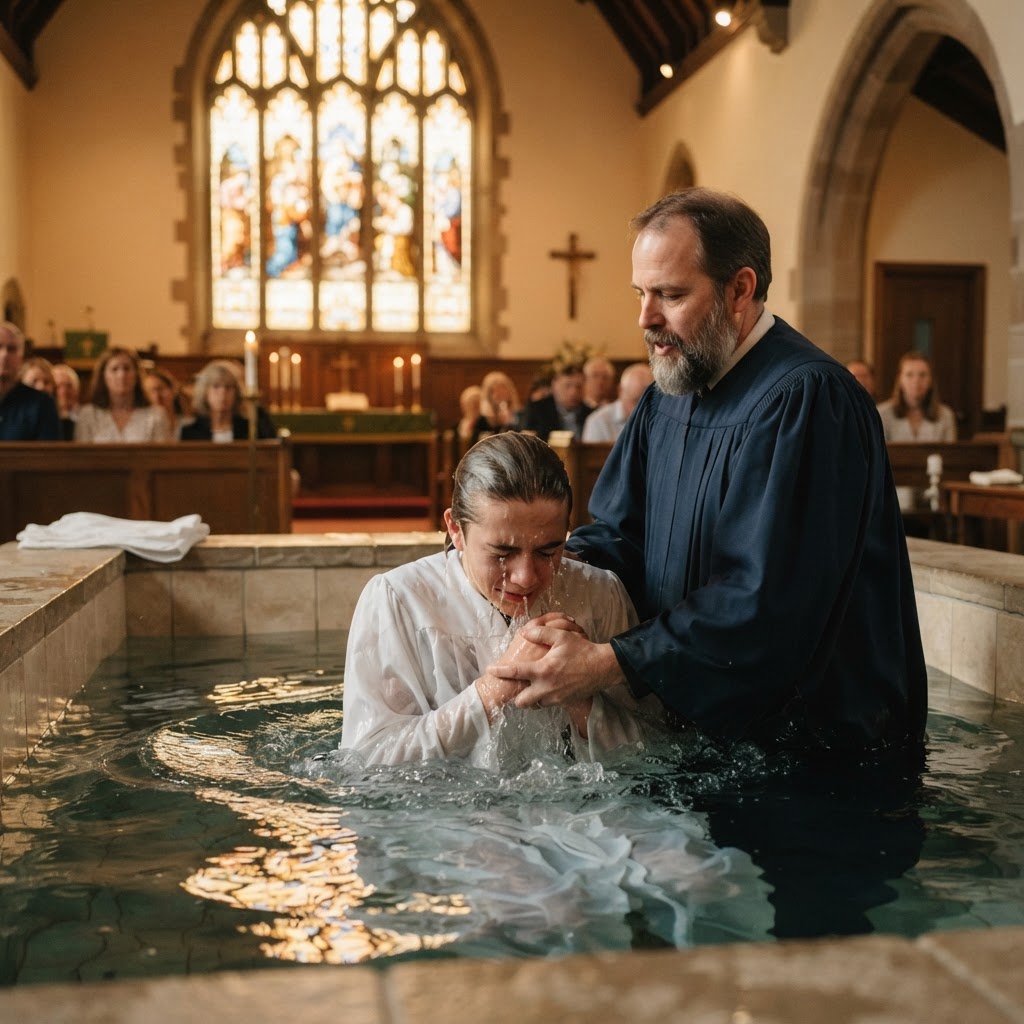
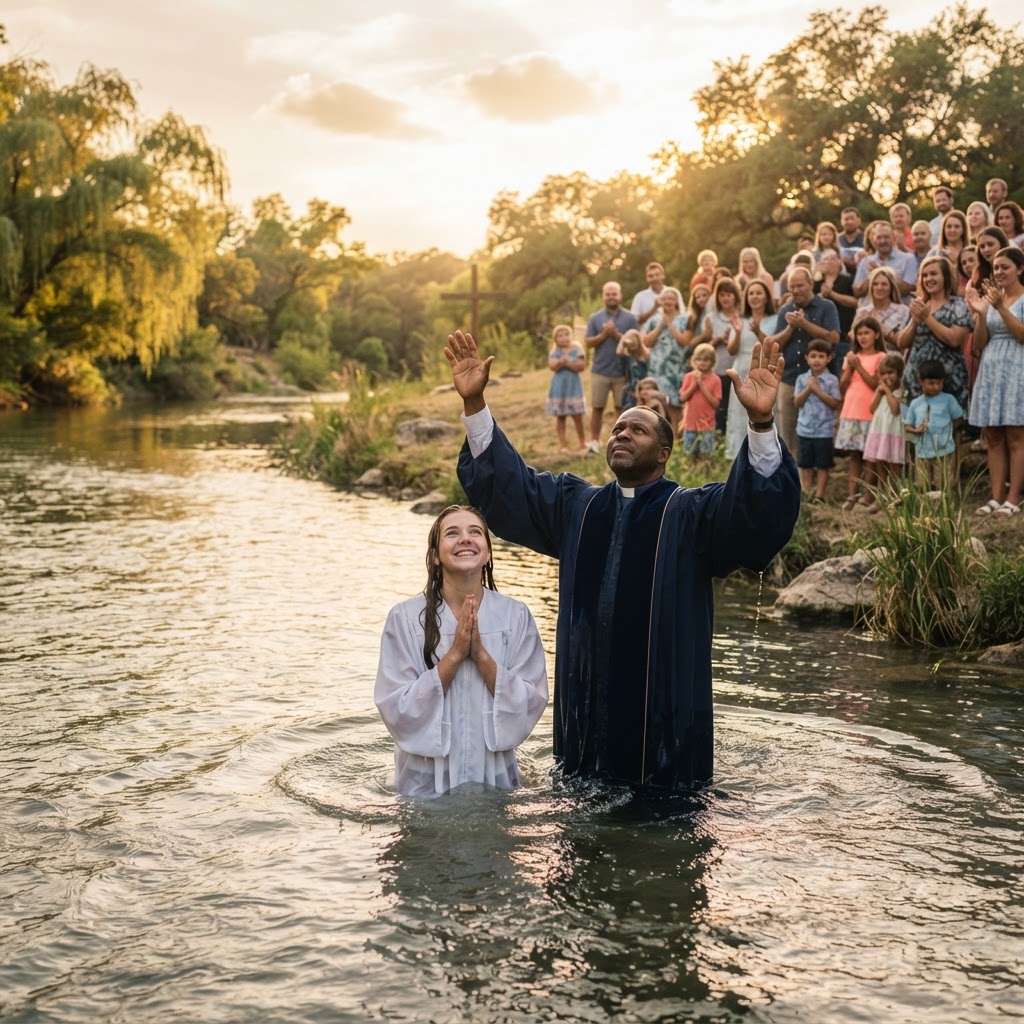
In a Baptist church, baptism is a joyful, ordered event. The candidate first gives a credible testimony of faith in Christ before the congregation. The pastor and candidate enter the baptistery (or a natural body of water for outdoor baptisms). The pastor supports the candidate and says, 'Based on your profession of faith in the Lord Jesus Christ, I baptize you in the name of the Father, and of the Son, and of the Holy Spirit' (Matthew 28:19). The candidate is gently lowered backward fully under the water and immediately raised up — picturing burial and resurrection (Romans 6:4–5). The congregation responds with celebration and welcome. Baptism is typically administered by the pastor or another ordained leader, though the validity rests on Christ's command and the candidate's faith, not on the officiant. Some Baptist churches also recognize that any believer may baptize in extraordinary circumstances, provided the candidate has made a credible profession and the act follows the biblical pattern.
Romans 6:4–5
"We were therefore buried with him through baptism into death in order that, just as Christ was raised from the dead through the glory of the Father, we too may live a new life. For if we have been united with him in a death like his, we will certainly also be united with him in his resurrection."
Matthew 28:19
"Therefore go and make disciples of all nations, baptizing them in the name of the Father and of the Son and of the Holy Spirit."
Check Your Understanding
1. What does the candidate do before being baptized?
2. What words does the pastor use?
3. What does the lowering and raising picture?
Lesson 10
Baptism and Church Membership
In Baptist polity, baptism is the doorway to church membership. Because baptism is the public profession of faith and the believer's identification with Christ and His body, Baptists require baptism as a prerequisite for membership and participation in the Lord's Supper. This reflects the New Testament understanding that baptism and the local church are inseparably linked — those who were baptized were 'added' to the church (Acts 2:41). Baptism identifies the believer with the universal body of Christ, and membership in a local Baptist church is the believer's commitment to a specific gospel community under godly leadership (Hebrews 13:17). Baptist churches are congregational in governance — members have a role in the church's decisions — so membership is both a privilege and a responsibility. The baptized believer commits to worship, serve, give, and submit to the church's care and discipline, fulfilling the 'one another' commands of the New Testament.
Acts 2:41
"Those who accepted his message were baptized, and about three thousand were added to their number that day."
Hebrews 13:17
"Have confidence in your leaders and submit to their authority, because they keep watch over you as those who must give an account."
Check Your Understanding
1. What role does baptism play in Baptist polity?
2. In Acts 2:41, what happened to those who were baptized?
3. What does membership in a local Baptist church involve?
Lesson 11
Living Out Your Baptism: New Life in Christ
Baptism is not a finish line — it is a starting line. The baptized believer is called to live out the reality baptism proclaims: dead to sin and alive to God (Romans 6:11). Paul writes, 'count yourselves dead to sin but alive to God in Christ Jesus.' This is the daily reality of the baptized life: turning from the old self, putting on the new self (Ephesians 4:22–24), walking in the Spirit (Galatians 5:16), and bearing the fruit of the Spirit (Galatians 5:22–23). Baptism commits the believer to a life of holiness, service, witness, and perseverance. It also anchors the believer in assurance — not because of the act itself, but because it points back to Christ's finished work and the believer's union with Him. As 2 Corinthians 5:17 declares, 'if anyone is in Christ, the new creation has come.' The baptized life is the lived 'Amen' to that promise.
Romans 6:11
"In the same way, count yourselves dead to sin but alive to God in Christ Jesus."
Galatians 5:22–23
"But the fruit of the Spirit is love, joy, peace, forbearance, kindness, goodness, faithfulness, gentleness and self-control."
Check Your Understanding
1. What does it mean to live out your baptism?
2. What does Romans 6:11 instruct?
3. What does baptism commit the believer to?
Lesson 12
Common Questions About Baptism
Several questions often arise. Should I be re-baptized? Baptists generally baptize once, but many recognize re-baptism when a person was baptized before a genuine conversion (e.g., as an infant or before true faith) and now wishes to obey Christ as a believer. What if I was baptized in another tradition? Most Baptist churches accept a prior baptism if it was believer's baptism by immersion following a credible profession of faith, regardless of denomination. What about baptism by sprinkling or pouring? Baptist churches typically ask those baptized by other modes to be baptized by immersion as a matter of conscience and obedience to the biblical pattern. Do I need to be baptized to take communion? In most Baptist churches, baptism precedes participation in the Lord's Supper, as both ordinances belong to the gathered church. What if I fear the water? Pastors are patient and will work with you to ensure the experience is reverent and peaceful — the obedience matters more than the comfort. In all things, baptism is about following Christ in simple, joyful obedience.
Acts 8:36
"As they traveled along the road, they came to some water and the eunuch said, 'Look, here is water. What can stand in the way of my being baptized?'"
1 Corinthians 11:28
"Everyone ought to examine themselves before they eat of the bread and drink from the cup."
Check Your Understanding
1. When might re-baptism be appropriate?
2. How do Baptist churches typically view a prior believer's baptism by immersion in another tradition?
3. In most Baptist churches, what precedes participation in the Lord's Supper?
I've Finished the Course
Fill in your information below and press submit. This lets the church office know you have completed the course so we can follow up with you about scheduling your baptism.