Youth Discipleship · Ages 10–20
The Baptism Course
A course to help you understand the Baptist view of baptism — what it means, why it matters, and how it is done — so you can take this important step of faith with confidence.
Before You Begin
This course has six short lessons. Read each one carefully, look up the Bible verses, and answer the three questions at the end of each lesson to check your understanding. When you are finished, complete the form at the bottom and press submit — a notification will be sent to the church office so we can follow up with you about your baptism.
Lesson 1
What Is Baptism?
Baptism is an outward sign of an inward change. It is a public declaration that you have placed your faith in Jesus Christ as your Lord and Savior. In the Baptist tradition, baptism does not save you — salvation comes by grace through faith in Jesus alone (Ephesians 2:8–9). As Jesus said in Mark 16:16, 'Whoever believes and is baptized will be saved.' Notice He put belief first. Baptism is a beautiful act of obedience that shows the world what God has already done in your heart. First Peter 3:21 reminds us that baptism is 'the pledge of a clear conscience toward God' — a response to salvation, not the cause of it.
Romans 6:4
"We were therefore buried with him through baptism into death in order that, just as Christ was raised from the dead through the glory of the Father, we too may live a new life."
1 Peter 3:21
"And this water symbolizes baptism that now saves you also — not the removal of dirt from the body but the pledge of a clear conscience toward God."
Check Your Understanding
1. What does baptism represent in the Baptist tradition?
2. According to Ephesians 2:8–9, how are we saved?
3. Why do we get baptized?
Lesson 2
Jesus Set the Example
Jesus Himself was baptized by John the Baptist in the Jordan River (Matthew 3:13–17). Even though He had no sin to repent of, Jesus chose to be baptized 'to fulfill all righteousness' (Matthew 3:15) and to identify with us. When He came up out of the water, the heavens opened, the Spirit of God descended like a dove, and the Father spoke from heaven: 'This is my Son, whom I love.' This moment shows all three Persons of the Trinity together — Father, Son, and Holy Spirit. If the Son of God humbled Himself to be baptized, how much more should we who have been saved by Him follow His example. John 1:29 records John declaring, 'Look, the Lamb of God, who takes away the sin of the world!'
Matthew 3:16–17
"As soon as Jesus was baptized, he went up out of the water. At that moment heaven was opened, and he saw the Spirit of God descending like a dove and alighting on him. And a voice from heaven said, 'This is my Son, whom I love; with him I am well pleased.'"
Matthew 3:15
"Jesus replied, 'Let it be so now; it is proper for us to do this to fulfill all righteousness.'"
Check Your Understanding
1. Who baptized Jesus?
2. Where was Jesus baptized?
3. What happened when Jesus came up out of the water?
Lesson 3
Believer's Baptism
Baptists practice believer's baptism — meaning baptism is for those who are old enough to understand the gospel and have personally chosen to follow Jesus. We do not baptize infants, because we believe baptism follows a personal decision to trust Christ. In the Bible, every person who was baptized first believed the message of Jesus and then was baptized as a response of faith. Acts 8:12 says, 'When they believed Philip… they were baptized, both men and women.' Acts 2:41 records that 'those who accepted his message were baptized.' The pattern is always the same: believe first, then be baptized. Jesus said in Mark 16:16, 'Whoever believes and is baptized will be saved' — belief comes first.
Acts 8:12
"But when they believed Philip as he proclaimed the good news of the kingdom of God and the name of Jesus Christ, they were baptized, both men and women."
Acts 2:41
"Those who accepted his message were baptized, and about three thousand were added to their number that day."
Check Your Understanding
1. Why don't Baptists baptize infants?
2. What must happen before someone is baptized?
3. What is the biblical pattern shown in Acts?
Lesson 4
Why Immersion?
The word 'baptize' comes from the Greek word 'baptizo,' which means 'to dip, plunge, or immerse.' Baptists baptize by full immersion — going completely under the water and coming back up. This method best pictures what baptism represents: being buried with Christ (going under the water) and raised to new life (coming up out of the water). Romans 6:4 says we were 'buried with him through baptism into death.' Colossians 2:12 says we were 'buried with him in baptism… and raised with him through faith.' Even the way Jesus was baptized supports immersion — Matthew 3:16 says He 'went up out of the water,' and Acts 8:38–39 says the Ethiopian eunuch and Philip 'went down into the water' and 'came up out of the water.' Sprinkling or pouring does not capture this powerful picture of death, burial, and resurrection.
Colossians 2:12
"Having been buried with him in baptism, in which you were also raised with him through your faith in the working of God, who raised him from the dead."
Acts 8:38–39
"And he gave orders to stop the chariot. Then both Philip and the eunuch went down into the water and Philip baptized him. When they came up out of the water, the Spirit of the Lord suddenly took Philip away."
Check Your Understanding
1. What does the Greek word 'baptizo' mean?
2. What does going under the water picture?
3. What does coming up out of the water picture?
Lesson 5
How Baptism Is Done — Step by Step
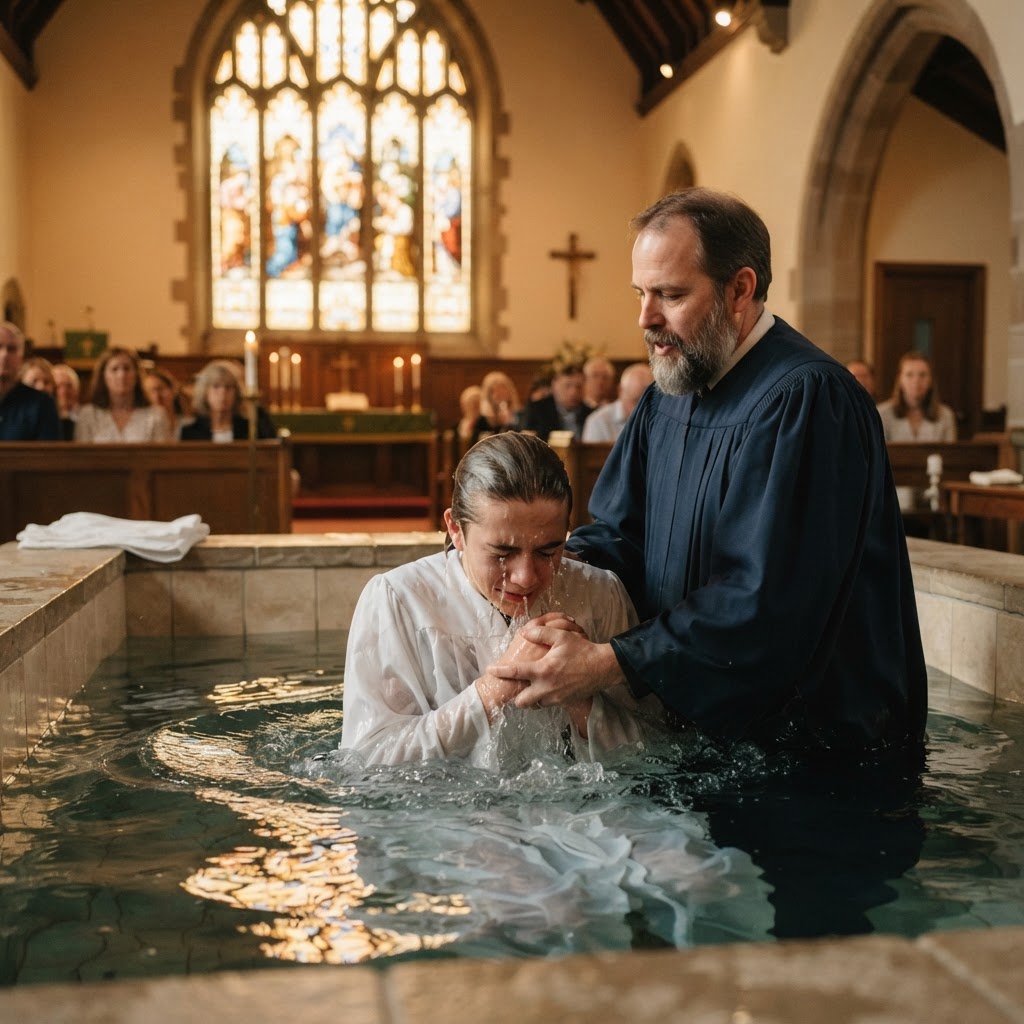
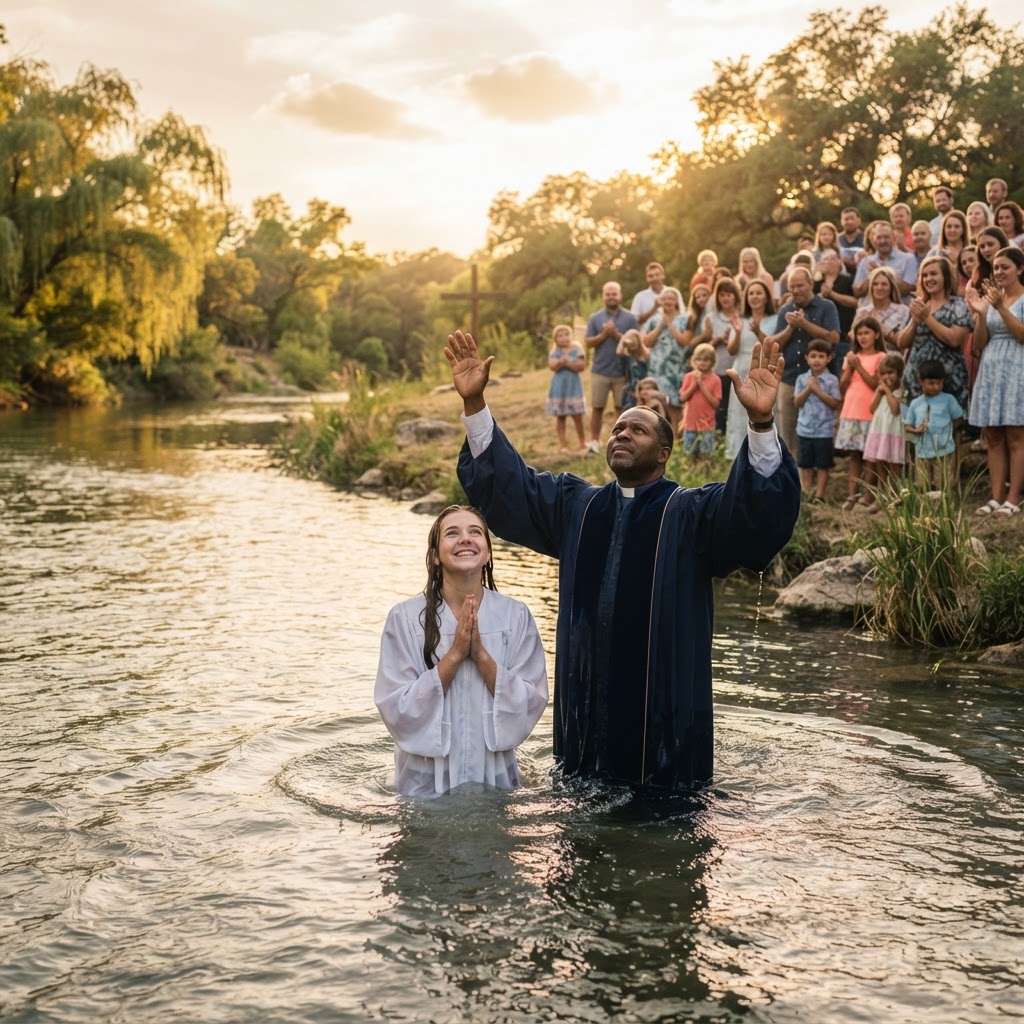
Here is what you can expect on the day of your baptism: (1) You will share a brief testimony of how you came to faith in Jesus, as Romans 10:9–10 teaches us to confess with our mouths. (2) You and the pastor will step into the baptistery — a pool of warm water in the front of the church (or a lake or river for outdoor baptisms, as Jesus was baptized in the Jordan). (3) The pastor will support you and say, 'I baptize you in the name of the Father, and of the Son, and of the Holy Spirit,' following Jesus' command in Matthew 28:19. (4) You will be gently lowered backward fully under the water, then immediately raised back up — picturing the burial and resurrection of Romans 6:4. (5) The congregation will celebrate and welcome you with joy, just as the angels in heaven rejoice over one sinner who repents (Luke 15:10). The whole moment usually lasts less than a minute, but it is one you will remember for the rest of your life.
Matthew 28:19
"Therefore go and make disciples of all nations, baptizing them in the name of the Father and of the Son and of the Holy Spirit."
Romans 10:9
"If you declare with your mouth, 'Jesus is Lord,' and believe in your heart that God raised him from the dead, you will be saved."
Check Your Understanding
1. What does the pastor say before lowering you into the water?
2. How are you lowered into the water?
3. Where does baptism typically take place?
Lesson 6
What Baptism Means for You
Baptism is not the end of your journey — it is the beginning. It is your first public step as a follower of Jesus. When you are baptized, you are telling your family, your friends, and your church family: 'I belong to Jesus, and I am following Him.' You are also identifying with Jesus in His death, burial, and resurrection (Romans 6:3–5). Galatians 3:27 says, 'For all of you who were baptized into Christ have clothed yourselves with Christ.' From this day forward, you are part of the body of Christ — the church — and you are called to grow in your faith, serve others, and share the good news of Jesus with the world (Matthew 28:19–20). As 2 Corinthians 5:17 says, 'If anyone is in Christ, the new creation has come: The old has gone, the new is here!' Baptism is your way of saying yes to that new life.
Galatians 3:27
"For all of you who were baptized into Christ have clothed yourselves with Christ."
2 Corinthians 5:17
"Therefore, if anyone is in Christ, the new creation has come: The old has gone, the new is here!"
Check Your Understanding
1. Is baptism the end of your journey or the beginning?
2. What are you declaring when you are baptized?
3. According to 2 Corinthians 5:17, what happens when anyone is in Christ?
I've Finished the Course
Fill in your information below and press submit. This lets the church office know you have completed the course so we can follow up with you about scheduling your baptism.